A driveway is the first thing people see and the slab that takes the most abuse. Concrete Commandos Bee Cave pours new and replacement concrete driveways for homes in Bee Cave and the Lake Travis area, with grade, drainage and joints planned for the lot you actually have.
New and replacement concrete driveways
Most driveway calls fall into three groups: a brand new driveway for a new build, a full tear-out and replacement of a slab that has cracked or settled, and an extension or widening of a driveway that no longer fits the cars in the family. We handle all three, and we talk through which one fits before anything is poured.
- New builds: forming, base prep, steel reinforcement and finishing coordinated with your builder's schedule.
- Replacement: demolition, haul-off, regrading the base and pouring a new slab.
- Extensions and widening: tying new concrete into an existing driveway with a clean, planned joint.
- Parking pads and aprons: extra space beside the garage or at the street.
Built for Hill Country lots
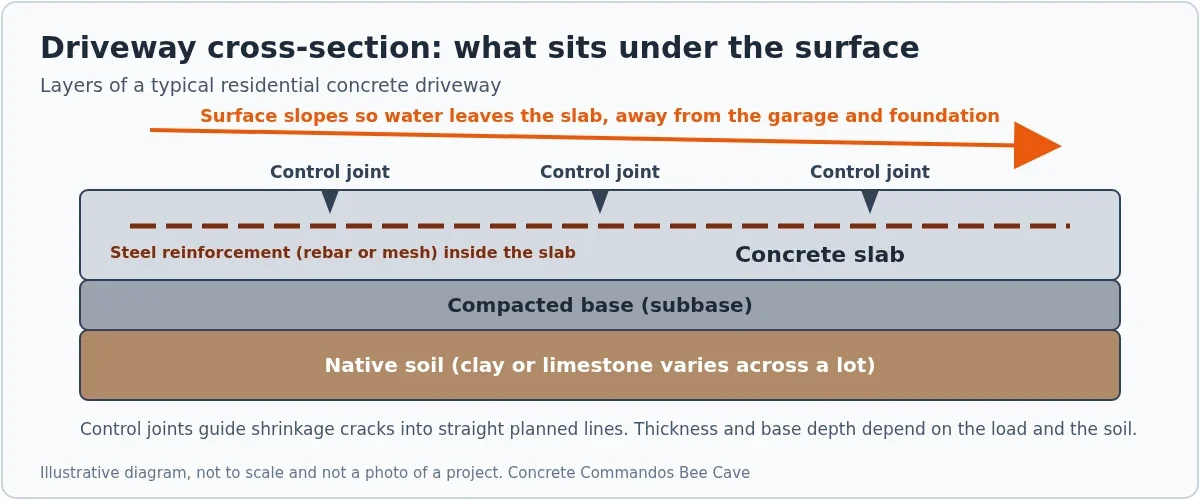
Driveways in Bee Cave and the surrounding Hill Country are rarely flat. Many lots slope toward the street, toward the house or toward a neighbor, and the ground underneath can change from shallow limestone to clay that swells and shrinks with moisture. A good driveway starts with how water leaves the slab, not with the finish.
- Grade and drainage: we set the slope so water runs away from the garage and off the slab instead of pooling at the apron.
- Base preparation: a compacted, consistent base helps the slab bear weight evenly, especially where fill or rock changes across the lot.
- Reinforcement and joints: steel reinforcement and planned control joints give cracks a place to form that you will not notice.
- Thickness: a standard residential driveway is commonly poured around 4 inches thick, and heavier loads such as trucks, RVs or a delivery truck turning on the slab often call for more. We recommend a thickness based on how the driveway will be used.
Finish options
A broom finish is the everyday standard because it gives traction when the surface is wet. Other popular choices include a smooth trowel border with a broom center, exposed aggregate, integral color, and decorative bands or borders. If you want a patterned look, see our page on stamped concrete.
HOA and permit notes
Many Bee Cave and Lake Travis neighborhoods have a homeowners association that reviews exterior changes, and driveway width, color and material can be part of that review. Some cities also review driveway work as part of grading or impervious cover rules. Check with your HOA and your city before work starts. Our West Lake Hills and Barton Creek pages cover two areas where those rules matter most.
How to care for a new driveway
Keep vehicles and heavy loads off new concrete until your installer says it has cured enough, which is usually about a week for normal vehicle traffic. Avoid de-icing salts and harsh chemicals, wash oil spills quickly, and consider a penetrating sealer once the slab has cured.
How a driveway project goes
- Talk through the goal: a new driveway, a replacement or a wider slab.
- Look at the lot: slope, drainage, access and any HOA rules, then a written scope.
- Prepare the base: an old slab comes out if needed, and the base is graded and compacted.
- Place and finish: forms, reinforcement and joints go in before the concrete is placed and finished.
- Cure and clean up: the slab cures, forms are pulled and the site is cleaned.
What affects driveway cost
Price comes from the job, not a flat rate. These are the factors that move an estimate, with no numbers promised here:
- Size and shape: more area and curves mean more material and forming.
- Thickness and reinforcement: heavier vehicles such as trucks and RVs call for a sturdier slab.
- Removal of an old slab: demolition and haul-off add steps before the new pour.
- Slope, fill and access: steep or rocky lots and tight access change the work.
- Finish: broom, exposed aggregate, color or borders each differ.
Concrete, asphalt or pavers?
Concrete is rigid and can crack, which is why joints and reinforcement matter. Asphalt is flexible but is usually sealed and resurfaced on a regular schedule. Pavers can be lifted and reset one at a time, but they can shift if the base moves. Cracked or sunken slabs may be candidates for concrete repair before a full replacement. If your driveway ties into a walkway or patio, plan the finish and joints for all of them together. Neighbors in Lakeway and Rollingwood should also check city construction rules.
Frequently asked questions
How long should I stay off a new concrete driveway?
Plan on keeping foot traffic off for a day or two and vehicles off for about a week, or longer if your installer advises it. Concrete keeps gaining strength for weeks, so avoid heavy loads early on.
Why do driveways crack even when they are poured correctly?
Concrete shrinks as it dries and moves with temperature and soil moisture. Control joints and reinforcement are there to guide cracking into straight, planned lines so the slab stays sound and looks clean.
Do I need a permit or HOA approval for a new driveway?
It depends on your city and your neighborhood. Some jurisdictions review driveways under grading or impervious cover rules, and many HOAs review driveway changes. Confirm both before work starts.
Can you widen or extend my existing driveway?
Yes. New concrete is tied into the old slab with a planned joint. The color and texture will not match perfectly because concrete changes as it ages, so we talk through that before pouring.
Where we pour concrete driveways
We serve Bee Cave and nearby communities. Each area page covers local neighborhoods and permit notes: