Not every damaged slab needs to be torn out. Concrete Commandos Bee Cave evaluates cracked, settled and worn concrete around Bee Cave and tells you honestly whether a repair makes sense or whether replacement is the better value.
Common concrete problems
- Cracks: hairline shrinkage cracks, wider structural cracks and cracks that move.
- Settling and uneven slabs: a section that has sunk or tilted, creating a trip hazard or sending water toward the house.
- Spalling and scaling: the surface flaking off in chips or sheets.
- Heaving and lifting: slabs pushed up by roots or soil movement.
- Stains and surface wear: oil, rust, fertilizer and a worn or rough finish.
- Broken edges and corners: chipped steps, curbs and slab edges.
Why concrete cracks and settles in Central Texas
Soils in many parts of Central Texas swell when they get wet and shrink when they dry, and Hill Country lots can switch from clay to rock within a short distance. Water that runs under a slab, a leaking sprinkler line or a gutter that dumps next to a walk can wash out the base. Tree roots add pressure. Identifying the cause matters because repairing a crack without fixing the water problem means the crack will be back.
Repair options
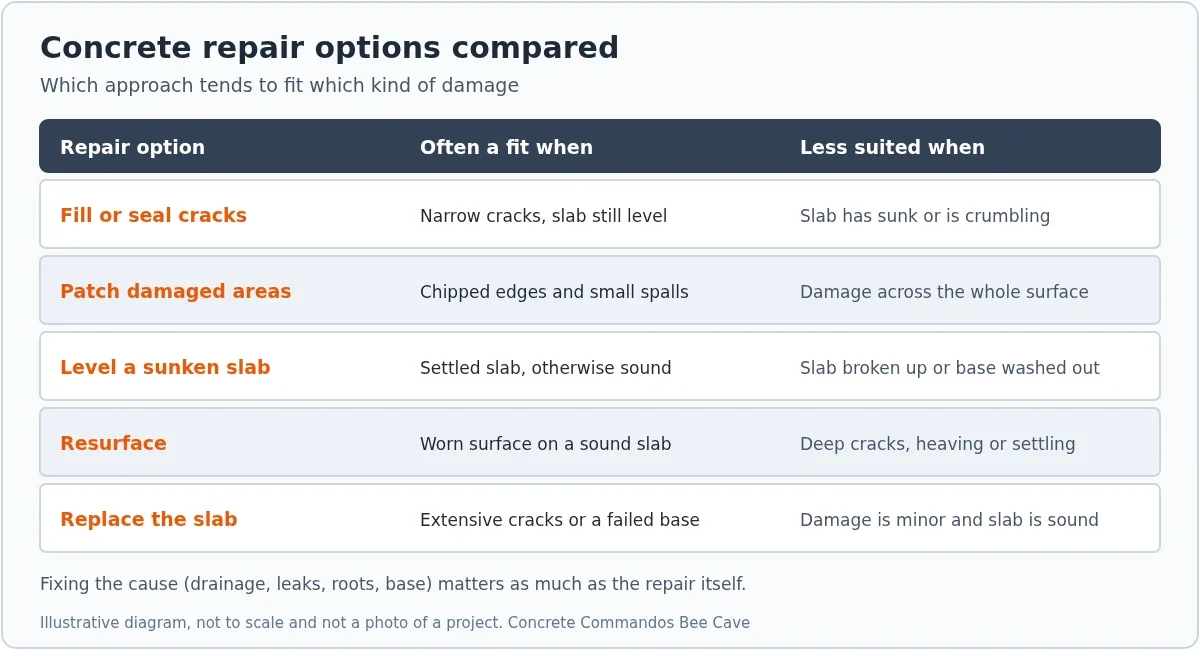
- Crack repair: routing and sealing with flexible sealants for moving cracks, or filling with a rigid material for stable ones.
- Section replacement: cutting out and replacing a damaged panel instead of the whole slab.
- Resurfacing: a thin overlay that can refresh worn concrete when the slab underneath is sound.
- Leveling: raising a settled slab or replacing it, depending on the cause and the size of the area.
- Edge and step repair: rebuilding broken corners and steps.
- Sealing: protecting repaired and sound concrete against water and stains.
Repair or replace?
Repair often works when the concrete is structurally sound and the damage is limited. Replacement is usually better when a large area is cracked in several directions, when the base has failed, or when the slab drains toward the house. For driveways and patios, replacement is an opportunity to correct grade and drainage. Learn more about concrete driveways and concrete patios. We explain the tradeoffs and let you decide.
Safety matters
A raised or sunken slab edge is a trip hazard, and water running toward a foundation is a bigger problem than it looks. If a slab touching your foundation has settled or is draining toward the house, call us early. Structural or foundation concerns can also call for a structural engineer or foundation specialist, and we will tell you if a problem is outside concrete flatwork.
Repair or replace: a checklist
These questions help sort a repair from a replacement:
- Is the slab still level, or has part of it sunk or tilted?
- Are the cracks narrow and stable, or wide, uneven or growing?
- Is the surface flaking over a small spot or across the whole slab?
- Is water, a roots problem or a washed-out base the cause?
- Would a repair match the rest of the slab well enough?
If most answers point to widespread movement or a failed base, replacement may be the better value. If the damage is local and the slab is sound, repair can make sense.
What resurfacing means
Resurfacing places a thin new layer over a sound slab to refresh a worn or rough surface. It does not fix a slab that is moving, so cracks that keep growing and settled sections need to be dealt with first. Surface prep and drainage matter for how well the new layer lasts.
What affects repair cost
- How much damage there is: a few cracks differ from a broken slab.
- The cause: fixing drainage, leaks or roots can add work.
- The method: sealing, patching, leveling, resurfacing and replacing differ in effort.
- Finish match: blending new work with old concrete takes care.
Common repair jobs include driveways, walkways and pool decks.
Frequently asked questions
Can cracked concrete be repaired instead of replaced?
Often yes, when the slab is otherwise sound. Narrow stable cracks can be filled or sealed. Widespread cracking, a failed base or ongoing settlement usually points toward replacement.
Will a repair be invisible?
Not always. Patches and sealed cracks are usually noticeable up close, and new concrete or sealer will not match old concrete exactly. We explain what to expect before work starts.
What causes concrete to flake or spall?
Water getting into the surface, a poor finish, too much water in the mix, or chemicals can cause scaling. Sealing and drainage improvements help prevent it.
Why did my driveway or patio sink?
Common causes include washed-out base material, poor compaction, leaks and drainage problems, and soil movement. We look at the cause so a repair does not fail the same way.
Do you repair concrete near a foundation?
We can repair and replace flatwork near a home, such as patios, walks and driveways. Concerns about the foundation itself are best reviewed by a qualified foundation or structural professional.
Where we pour concrete repair
We serve Bee Cave and nearby communities. Each area page covers local neighborhoods and permit notes: