A patio is where a Bee Cave home turns into a place to live outside: morning coffee, a grill, a fire pit, a long table under a pergola. Concrete Commandos Bee Cave builds concrete patios that are sized for how you will really use them and finished to hold up in Texas sun and Hill Country rain.
Concrete patios for Bee Cave homes
Concrete is the most flexible patio material for a Central Texas yard. It can be poured to nearly any shape, sloped to shed water, colored, textured or patterned, and it fits budgets from simple to custom. We pour patios behind new homes, add them to existing homes, and replace worn-out slabs and failing pavers.
- Backyard entertaining patios sized for a dining set, grill station and lounge area.
- Covered patios and pergola slabs poured to match the roofline and posts.
- Fire pit and outdoor kitchen pads with the thickness and reinforcement those loads need.
- Front entry and courtyard patios that connect to your walkways and driveway.
- Patio extensions that add square footage to an existing slab.
Planning the layout
The best patios are planned before the first form is set. We walk the yard with you and work through the questions that decide whether a patio feels right a year from now.
- Size: how many people you want to seat, where the grill and traffic paths go, and how much room furniture needs to move around.
- Shape and edges: a clean rectangle, a curved edge that follows a garden bed, or a cutout for a tree you want to keep.
- Elevation: where the patio meets the door threshold, and how it steps down to the yard.
- Utilities: gas lines, electrical, irrigation and drain lines that should be in place before concrete covers them.
- Shade: the Texas sun heats a dark slab quickly, so we talk through color, finish and shade structures.
Drainage comes first
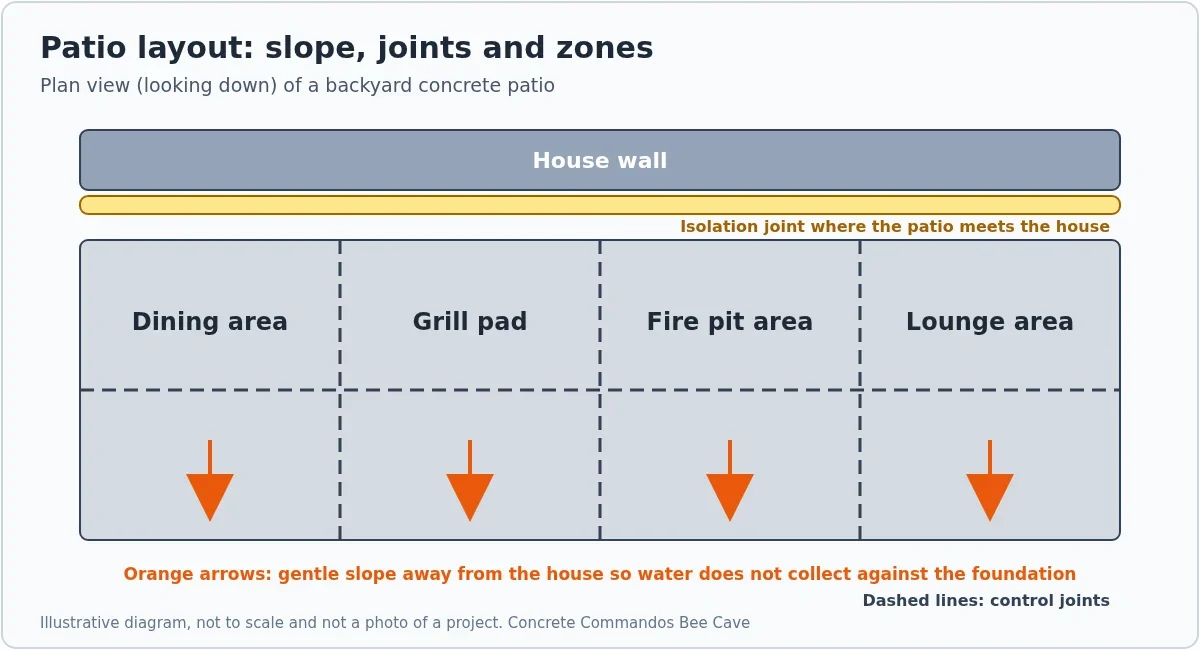
Hill Country yards often slope, and rain can arrive fast. A patio should shed water away from the house foundation, away from the neighbor, and not into a low spot that stays wet. We set a gentle slope across the slab and plan where water goes after it leaves the concrete. On a hillside lot that may mean a swale, a drain or a different elevation than you first pictured.
Finish and color choices
- Broom finish: the practical standard with good traction.
- Smooth trowel: a cleaner look that is best for covered areas, since it can be slick when wet.
- Exposed aggregate: a washed surface where the stone shows, popular around pools and entries.
- Integral color and stain: color mixed into the concrete or applied to it, from natural gray to warm earth tones.
- Saw-cut patterns: clean decorative lines that double as control joints.
- Stamped patterns: stone, slate, brick and wood looks. See our stamped concrete page for the details.
Joints, thickness and reinforcement
Patio concrete is commonly poured around 4 inches thick, with thicker sections or footings where a pergola, outdoor kitchen or wall will sit. Steel reinforcement and control joints keep the slab together and guide shrinkage cracks to straight lines. Isolation joints separate the patio from the house, steps and posts so each can move on its own.
HOA and permit notes
Patio slabs, covers and outdoor kitchens often need HOA approval, and some cities treat a new patio as added impervious cover that counts toward lot limits. In neighborhoods such as Steiner Ranch, exterior work typically goes through the association's review process. Check with your HOA and your city before you finalize a design.
Care and sealing
Let new concrete cure before furniture, a grill or a fire pit goes on it. A penetrating sealer helps resist stains from grease, leaves and fertilizer, and a sealed patio is easier to clean. Sweep regularly and hose off pollen and dirt.
How a patio project goes
- Plan the layout: furniture, grill and shade are sized on paper before forms are set.
- Prepare the ground: grade for drainage, then build a compacted base.
- Set forms, joints and reinforcement: joints are laid out so cracks follow straight lines.
- Place and finish: the surface is finished in broom, color, aggregate or a stamped pattern.
- Cure and seal: the patio cures before use, and sealing is added when it is ready.
What affects patio cost
- Size and shape: square footage and curves drive materials and forming.
- Loads: a fire pit, outdoor kitchen or pergola posts need extra thickness or reinforcement.
- Finish and color: broom, exposed aggregate, integral color and stamping vary in effort.
- Existing surface: removing an old slab or pavers adds demolition and haul-off.
- Drainage and access: sloped yards and tight gates change equipment and grading.
Concrete, pavers or flagstone?
Concrete gives one continuous surface that can be shaped, colored or stamped. Pavers can be repaired piece by piece, though joints can settle or grow weeds over time. Flagstone has a natural look but an irregular surface for chairs and tables. In Central Texas, clay soil that swells and shrinks moves every hard surface, so a good base and drainage matter for all three. If your patio will meet a pool deck, a walkway or a driveway, match joints and finish across them. Homeowners in Steiner Ranch and Lakeway should confirm HOA review before a pour.
Frequently asked questions
What size patio should I build?
Start with how you will use it. A table for six with room to move around usually needs a footprint noticeably larger than the table itself, and a grill or lounge area adds more. We sketch the layout with your furniture in mind and suggest a size that works.
What is the best patio finish for Texas heat and rain?
A broom or exposed aggregate finish gives traction when wet. Lighter colors stay cooler in the sun than dark ones. We help you balance look, traction and heat.
Can you pour a patio on a sloped yard?
Often yes. Slopes are common in Bee Cave and the Hill Country. We plan the elevation, drainage and any step downs or retaining details so the patio is level enough to use and still sheds water.
Can you replace my cracked patio?
Yes. We remove the old slab, correct the base and drainage, and pour a new patio. If the problem is limited to cracks or surface wear, concrete repair may be an option.
How soon can I use a new concrete patio?
Light foot traffic is usually fine after a day or two. Wait about a week before heavy furniture or a grill, and longer before a hot fire pit or heavy equipment, or as your installer recommends.
Do patios need control joints?
Yes. Concrete shrinks as it cures, and joints give it a planned place to crack. We lay out joints to line up with the shape of the patio so they look intentional.
Where we pour concrete patios
We serve Bee Cave and nearby communities. Each area page covers local neighborhoods and permit notes: